

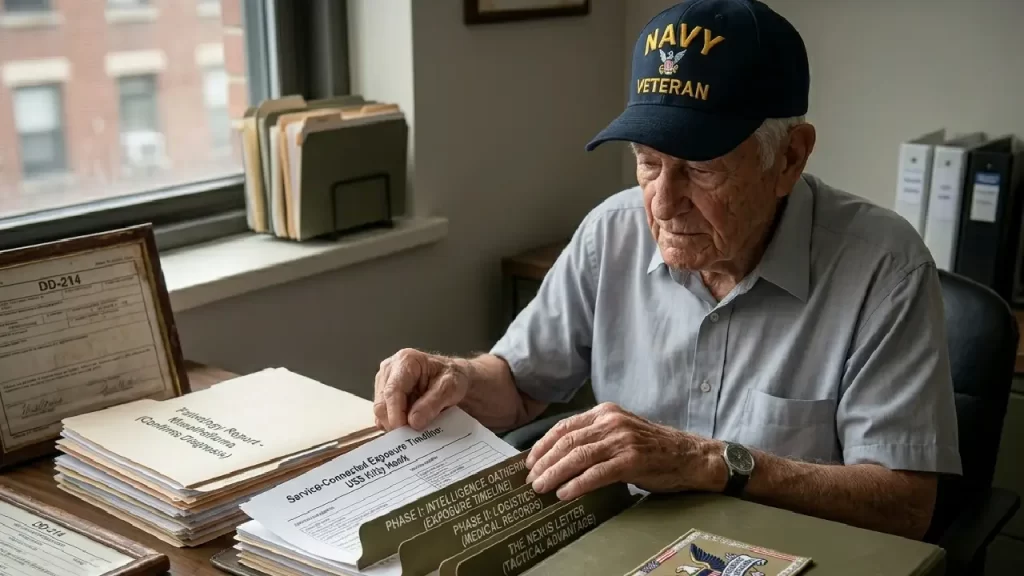
In the military, mission success depends on logistics. Whether it was a flight deck operation, a convoy in the desert, or maintaining a machine room, you never went into a mission without the right gear and a clear plan. When facing a diagnosis of mesothelioma or asbestos-related lung cancer, your new mission is navigating the complex healthcare and compensation systems. To secure your future, you must treat your medical and military documentation with the same discipline as a Standard Operating Procedure (SOP).
At the Mesothelioma Fund Administration, we bridge the gap where service-connected exposure meets financial recovery. Before you can access private trust funds or VA benefits, you must “armor” your case with organized records. This guide frames your document collection as a military-style operation, ensuring no Veteran is left behind due to a lack of paperwork.
Phase I: Intelligence Gathering – Mapping Your Exposure Timeline

Every mission starts with intelligence. In the context of asbestos litigation and VA claims, “intel” means a comprehensive timeline of where and when you were exposed. Because mesothelioma has a long latency period, often appearing 20 to 50 years after service, your memory of specific job sites is your most valuable asset.
Mapping Your Military Occupational Specialty (MOS)
Asbestos was ubiquitous in the military until the late 1970s. It was in the gaskets of Navy ships, the brakes of Army trucks, and the insulation of Air Force hangars. You need to identify every “Duty Station” and “Unit” where you served.
- High-Risk Roles: Boiler Technicians, Hull Technicians, Engine Room Mechanics, and Pipefitters.
- Objective: Document specific tasks where you handled “lagging,” gaskets, or insulation.
The DD-214: Your Primary Deployment Record
The DD-214 is the cornerstone of your Medical Mission. It proves your honorable service and lists your specialty codes. Without a clean, legible copy, your ability to file a VA mesothelioma claim or access Private Asbestos Trust Funds is stalled. If yours is lost, request a replacement via the National Archives immediately.
“Veterans who were exposed to asbestos during their military service may be eligible for various VA benefits, including disability compensation.” — U.S. Department of Veterans Affairs
Phase II: Logistics – Organizing the “War Room” Binder
Once you have gathered your intel, you need a central repository. Medical professionals and legal advocates need to see the full picture quickly. Creating a physical or digital “War Room” Binder allows you to provide “Urgent Care” for your claim.
Categorizing Medical Records for Fast Review
Organize your medical records into three distinct sectors to avoid delays:
- Diagnostic Imaging: X-rays, CT scans, and PET scans showing pleural thickening or tumors.
- Pathology Reports: The specific biopsy results that confirm a mesothelioma diagnosis.
- Treatment History: A chronological list of surgeries, chemotherapy, or radiation.
The “Buddy Statement” Force Multiplier
Sometimes official records are incomplete. “Buddy Statements” (VA Form 21-10210) act as corroborating evidence. If a fellow sailor remembers the specific asbestos lagging you worked with on a particular ship, their testimony can be the tactical advantage that wins your case.
Phase III: Strategic Communication – Bridging VA & Trust Funds
A major misconception is that Veterans must choose between VA benefits and legal settlements. This is incorrect. You can, and should, pursue both.
The Nexus Letter: Your Tactical Advantage
To win a VA claim, you need a Nexus Letter. This is a document from a medical professional that explicitly links your diagnosis to your military service. By having your service records organized, you make it easier for a doctor to state your illness is “at least as likely as not” caused by military asbestos exposure.
Filing with Private Asbestos Trust Funds
While the VA provides monthly compensation, private trust funds are set up by the companies that manufactured the asbestos products. These funds have billions of dollars set aside specifically for Veterans.
- Strategic Link: Having your MOS and ship history organized allows our advocates at the Mesothelioma Funds Administration to identify exactly which “defendant” products you handled, speeding up your payout.
Phase IV: Execution – The 72-Hour Response Plan
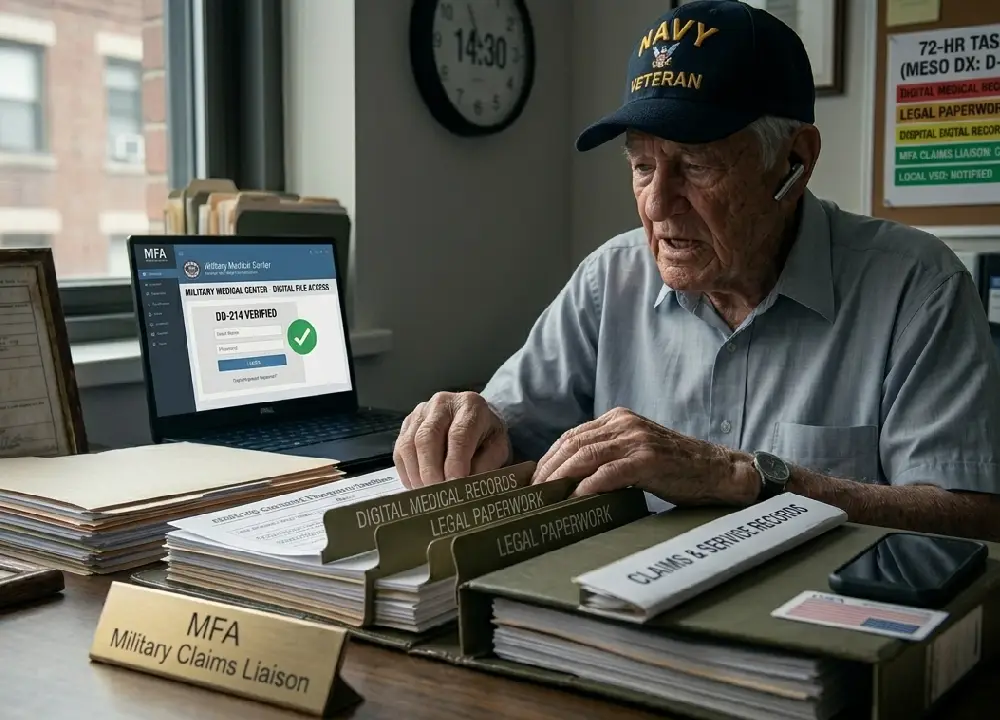
Mesothelioma is aggressive. In the military, “speed is life.” You do not have months to wait for paperwork. Once a diagnosis is suspected, move into the execution phase within 72 hours:
- Secure Digital Records: Request a digital copy of your entire file from the hospital.
- Identify Your Advocate: Connect with a Lead Military Claims Liaison at the Mesothelioma Funds Administration who understands the intersection of military service and asbestos law.
- Notify your VSO: Inform your local Veteran Service Officer, but ensure you are also pursuing private fund options, which VSOs generally do not handle.
Final Summary of the Medical Mission
You served your country with honor. Organizing your records isn’t just “paperwork”—it is a continuation of your service to your family. By treating your diagnosis as a military operation, you remove chaos and replace it with a structured path to the benefits you earned.
Move out, get organized, and take command of your recovery.
Author: Larry Gates, Lead Veteran Advocate at Mesothelioma Funds Administration.
Disclaimer: Mesothelioma Funds Administration is a private advocate site and is not affiliated with the U.S. Department of Veterans Affairs.
Strategic Veteran Insight: According to the American Journal of Public Health, Veterans account for approximately 30% of all mesothelioma deaths in the United States, highlighting the critical need for specialized military-to-settlement claim processing.